
Delta Correctional Release Paths
Delta Correctional Facility is part of MDOC's state system. Leaving Delta can mean a move to another MDOC institution, physical release to parole, placement on Earned Release Supervision, or actual release followed later by final discharge. A transfer ends the Delta placement but not state custody. Parole ends incarceration while supervision continues. ERS also puts an eligible person in the community while the person remains an inmate under MDOC jurisdiction through sentence expiration.
For that reason, no single missing location field proves freedom from custody. The offender detail should be read with the separate parolee result and the state release record. Final discharge means the sentence and governing supervision have ended. The discharge certificate and MDOC Records response provide stronger confirmation than a projected date.
| MDOC event | What it means | Best confirmation |
|---|---|---|
| Institution transfer | State custody continues elsewhere | Location and Location Change Date |
| Parole | Physical release with parole supervision | Parolee search and release record |
| ERS | Community placement with inmate status | MDOC Location and supervision record |
| Final discharge | Sentence and supervision ended | MDOC discharge record |
Search Delta Release Records
Begin with the MDOC inmate search. Search by first and last name or MDOC ID, open the matching detail, and compare date of birth, ID, county of conviction, sentence, and physical descriptors. Then read Location, Unit, Location Change Date, and Tentative Release Date together. Common-name matches require care.
- Identify the person by MDOC ID when possible.
- Open the official offender detail and note the current Location and change date.
- Read the exact Tentative Release Date label as a calculation, not an actual event.
- Search the separate parolee form by name, ID, city, or county when parole is possible.
- Request actual release, supervision placement, discharge-certificate date, and final discharge from MDOC Records.
The county Leflore released-inmate search covers local jail releases, but Delta must stay on the state path. A county bond record cannot confirm a Delta discharge, just as a tentative state date cannot establish a prior county release.
Note: A non-prison MDOC Location can show community supervision, not the end of MDOC jurisdiction.
Delta Offender Detail Fields
An MDOC detail can display a photograph, full name, MDOC ID, date of birth, physical traits, entry date, current Location and Unit, Location Change Date, sentence count and total length, offense, sentence date, county of conviction, and Tentative Release Date. It does not promise that every fully discharged person remains searchable. MDOC also publishes no search-page retention period or update cadence.
The field called Tentative Release Date is not a gate event. Time credit, sentence corrections, multiple sentences, parole action, discipline, and supervision changes can alter the calculation. A past date, missing result, or non-prison location must be followed by a record request when the precise legal status matters.
- Parole
- Release from incarceration under continuing supervision.
- Earned Release Supervision
- Early community placement while inmate status and MDOC jurisdiction continue.
- Discharge
- The end of the sentence and any controlling supervision.
- Detainer
- A request or hold from another authority that can change where custody goes next.
Delta Facility Release Contacts
The official Delta facility page confirms its state-facility role and contact. The main number is a facility contact, not a promised public release-status or records line. MDOC Records handles documentary release, discharge, time, jail-credit, and eligibility questions.
The official page view below confirms Delta's present MDOC status and location.
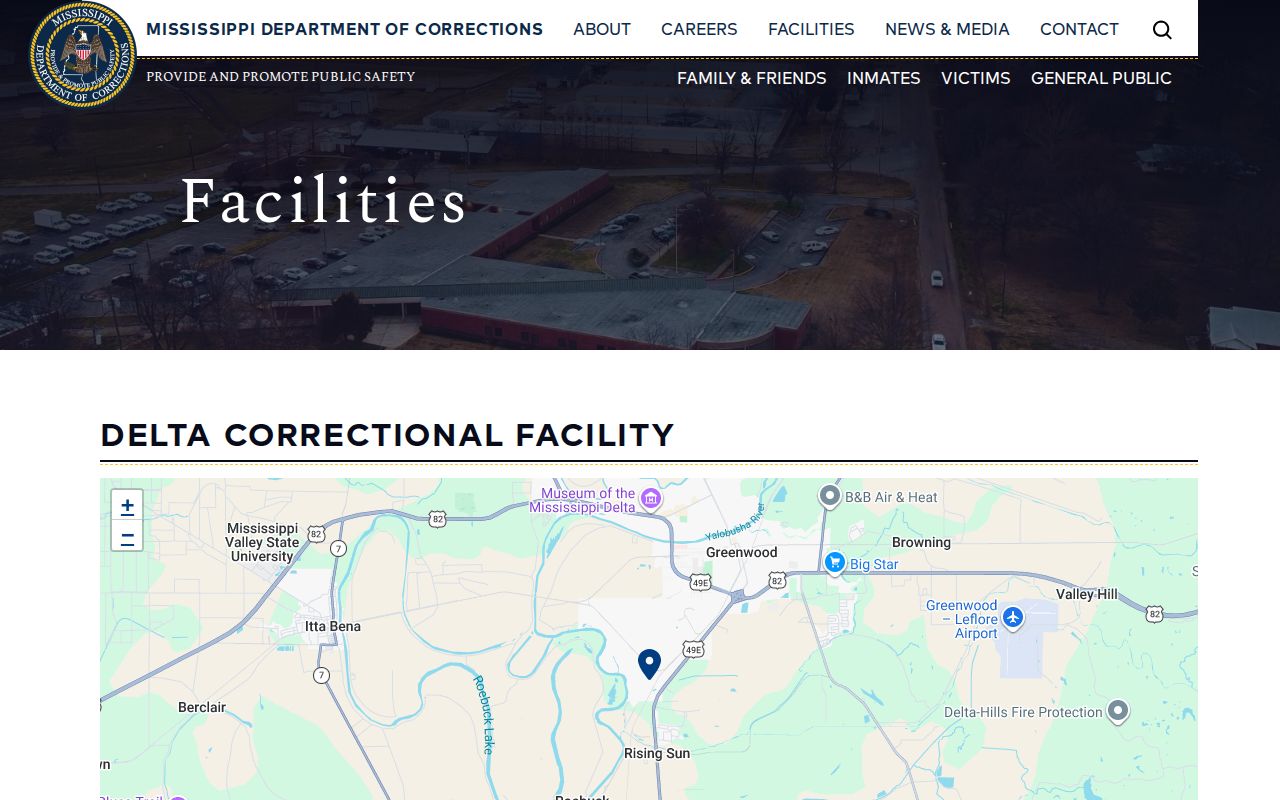
This image supports the facility identity and contact route, while a named offender's release still requires the offender and records channels.
Delta Correctional Facility3800 Baldwin Road, CR 540
Greenwood, MS 38930
Phone: 662-455-7277
MDOC Records
P.O. Box 24388
Jackson, MS 39225
Phone: 601-933-2889
Email: MDOCRecordsDepartment@mdoc.state.ms.us
Formal MDOC public-record requests must be written and are not accepted by telephone. Use the general-public records route and ask MDOC to distinguish physical release, parole or ERS placement, discharge-certificate issuance, and final discharge.
How Delta's History Changes Records
Delta's changing mission is essential to old release records. MDOC reported that Delta closed as a private prison in 2012. It reopened in April 2018 after technical-violation, restitution, and community-work operations were consolidated there. In 2022, it moved from Community Corrections into the Institutions Division as a major state facility.
An older record naming the Leflore Technical Violation Center, Greenwood Restitution Center, or “Delta TVC” may describe an earlier operational role. Those names should not be treated as open independent facilities today. A technical-violation placement also should not be interpreted through Delta's current institutional mission without checking the record date and MDOC location history.
The location label must be attached to time. Ask for the location-change record and the event that ended the placement. The state facility directory establishes the current institution, while MDOC's consolidation materials explain why historical names differ.
Note: Former Leflore TVC and Greenwood Restitution Center references are historical record clues, not current search destinations.
Delta Release Planning Records
MDOC's statewide release FAQ says the release process can take 30 to 45 days. The case manager gives the inmate the actual date, verifies travel, and coordinates required release steps. A discharge certificate is required before release. These are statewide MDOC rules, not a Delta gate schedule.
On request, MDOC can buy in-state bus travel to the destination or nearest city, but not out-of-state travel. No verified Delta exit time, pickup point, weekend rule, or waiting area was found. Contact the case manager through proper channels for the actual plan and do not treat the tentative public date as a pickup appointment.
Request Delta Release Proof
A precise MDOC request should name the offender and MDOC ID, then ask for the actual physical-release date, release type, parole or ERS placement, receiving location if transferred, discharge-certificate date, and final supervision-discharge date. If an institutional photograph is relevant, request the releasable photo separately. County booking photographs and MDOC institutional images are not interchangeable.
Ask MDOC Records about offender time, jail credit, and eligibility rather than calling Delta's main line as though it were a public records office. For parole, the Mississippi State Parole Board can route questions about individual action, while the parolee search shows public supervision results. No current public person-by-person Parole Board hearing calendar or decisions database was found.
If BOP, ICE, USMS, or another state appears as the next custodian, follow that authority's system. “Not at Delta” may be transfer, community supervision, or discharge. The complete custody chain is what resolves the release.
Delta Release Dates Need Proof
MDOC's public date is expressly tentative. It reflects time computation based on sentence information, applicable jail credit, sentence structure, earned-time eligibility, and other state calculations. Multiple sentences can run at the same time or one after another. Court corrections, time-credit changes, discipline, parole action, and supervision revocation can change the expected endpoint.
Mississippi Code section 47-5-138 provides earned-time rules and helps explain why a public estimate can differ from the full sentence length. For many sentences imposed after June 30, 1995, an eligible person may earn 4.5 days for each 30 days served, ordinarily subject to a 15-percent cap, conduct and performance rules, exclusions, exceptions, and forfeiture. That is not an automatic promise of release after 85 percent. Older sentences can follow a different structure.
Parole eligibility is another distinct date. It marks when consideration may occur, not when Delta must release the person. A parole grant can still precede conditions and operational steps. Likewise, ERS places an eligible person outside the institution while inmate status continues. These distinctions explain why the same public record can show a community-supervision Location and a future Tentative Release Date.
Use a confirmation ladder: public tentative date, current case-manager plan, actual release entry or discharge certificate, parole or ERS record, and final discharge. Ask MDOC Records for the exact rung needed. No Delta-specific public release calendar, gate time, or weekend rule was found, so the statewide evidence should not be turned into a local schedule.
Identity checks remain part of date verification. Compare the MDOC ID, date of birth, county of conviction, offense, sentence date, and sentence length before relying on a displayed calculation. A shared name can lead to the wrong tentative date, while an old screenshot may no longer reflect a current Location or supervision event. Save the date the official record was reviewed, then seek a current response when travel, court action, or a custody transition depends on it.
Public Record Search
Sponsored Results